Research
Our group studies ocean dynamics using a combination of theory, numerical ocean models, and scalable python-based analysis tools. A few of our current projects are highlighted below.
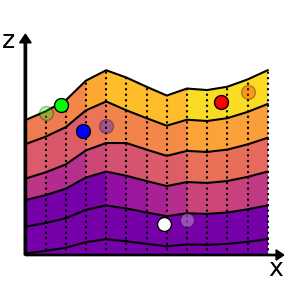
Adding virtual particles to MOM6
Virtual particles can be used to investigate the pathways of heat, carbon, nutrients and other tracers through the ocean. In this project, we are adding code to MOM6 (a state-of-the-art ocean model) to allow particles to be advected at the same time as the model is running. We are also using these particles to characterize how water from the North Brazil Current flows northward across the equator as part of AMOC.
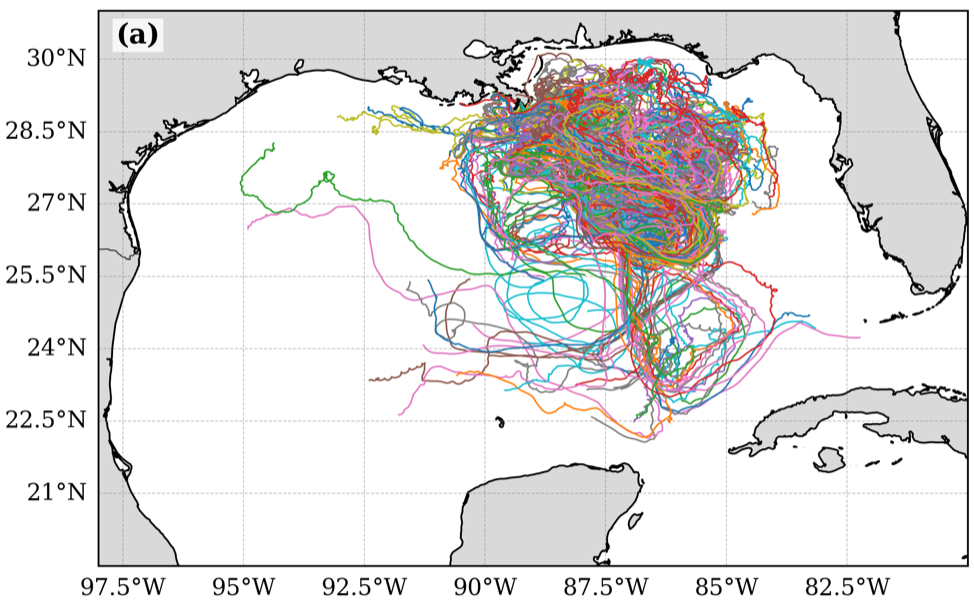
Using drifter data to characterize the energy spectrum at the ocean surface
The ocean surface velocity field contains energy at a range of different scales. While the velocities at the large scale can be inferred from satellite data, the small scales must be measured using in-situ instruments such as surface drifters. In this project, we are developing mathematical tools to estimate the ocean surface kinetic energy spectrum from drifter data.